
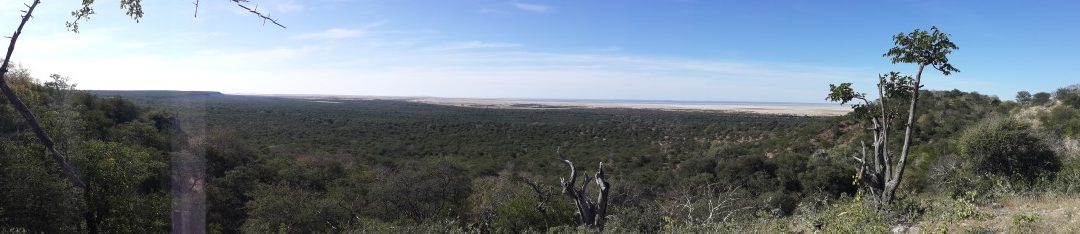
Botswana border to border. Salt pans, sand tracks, and the distances that test your gear setup.
There is a specific kind of silence you only find in the middle of Botswana. Not the quiet of a forest or the hush of early morning. This is the silence of a country that is simply very large and mostly empty, interrupted only by the low thrum of a 1,300cc flat-twin and the distant call of something you cannot identify.
I crossed into Botswana at Tlokweng Gate east of Gaborone on a Tuesday morning in early June — dry season, cold nights, perfect riding days — and I did not leave until I crossed out at Kazungula eleven days later, having covered just over 2,800 kilometres of the most varied, demanding and honest riding I have done in twenty years on big adventure bikes.
The gear on the BMW R 1300 GS — Motorradical panniers, top box and mounting hardware — went on before I left Pretoria. It came off in Kasane, Botswana, almost two weeks later. In between, it was rained on once, dragged through deep sand three times, dropped hard on a corrugated gravel track outside Nata, and loaded and unloaded at eleven different campsites and guesthouses. The mounts never moved. The locks held. The seals kept the dust out. This is not a gear review. It is what happened.
Why Botswana, Why This Route
The Trans-Kalahari is not a single road. It is a loose idea — cross Botswana from south-east to north-west, or in my case south-east to north, following whichever roads feel right on the day. There are tarred highways if you want them. There is also deep Kalahari sand if you go looking, which I did.
The appeal is the scale. South Africa has spectacular riding, but it is a country that eventually shows you a fence or a town or a petrol station. Botswana does not do that. You can ride for three hours without seeing another vehicle. Fuel planning is not optional. Water planning is not optional. The ground is flat and the sky is enormous and the distances between things are long enough to make you take seriously the question of what you are carrying and why.
I had done parts of this route before on a lighter bike with soft bags. This time I wanted to do it properly — fully loaded, camping kit, tools, water capacity for 400 kilometres between reliable sources, camera equipment, and still be able to ride the sand sections without cursing my choices. The Motorradical setup on the 1300 GS was the answer to that problem.
Gaborone to Jwaneng: Finding the Rhythm
The first day south of Gaborone is unremarkable by Botswana standards, which means it is excellent by any other measure. The A1 runs south-west through flat bush country toward Lobatse and then the road opens up west toward Jwaneng — the world’s richest diamond mine, surrounded by wire fencing and nothing else for a long way in each direction.
I stopped outside Jwaneng to adjust the panniers. Not because they needed adjusting — they did not — but because I had not yet trusted them in the corners and I wanted to check. Six bolts per side, tight. The mounting plates were flush against the subframe. I checked the top box. Same. Three hundred kilometres done, everything solid, and I settled into the riding properly from that point.
The road surface between Gaborone and Jwaneng is good tarmac interrupted by the occasional large pothole and the certain knowledge that a truck is going to pull out of a gravel side road at exactly the wrong moment. The 1300 GS handles this kind of riding with barely any effort. The weight of the loaded luggage — I was carrying roughly 35 kilograms across the three pieces — was noticeable at low speed but invisible above 80km/h.
Overnight at a small guesthouse on the edge of Jwaneng town. Pula 350, a room with a working shower, and a woman who cooked me the best beef stew I have eaten in southern Africa. The panniers went on the room floor. I did not bother unloading the top box.
The Kalahari Proper: Jwaneng to Kang
This is where Botswana starts to mean business.
West of Jwaneng the tarmac continues for a while and then the landscape simply takes over. The scrub thickens and then thins to nothing and then you are in the Kalahari proper — low grey-green bush, red sand, and a road that looks straight on the map and is straight in reality, for 200 kilometres at a time.
I left the main road outside Sekoma and headed north-west on a track marked on my GPS that turned out to be, in alternating sections, firm gravel, soft sand, and compressed cow track. This is the Kalahari. You do not always get to choose which one you are riding.
The sand was the problem, as sand always is on a loaded 260-kilogram bike. The R 1300 GS is better in sand than it has any right to be — the electronic suspension adjustment, the traction control set to offroad mode, the broad knobby tyres — but a fully-loaded big adventure bike in deep sand is still a test of commitment and body position. I dropped it once, slowly, in a soft section near a cattle post. The right pannier hit the ground first and took the full weight of the bike.
It bounced. There is no other word for it. The pannier took the impact, the aluminium lid flexed slightly and returned, and when I got the bike upright again the lock still closed cleanly and nothing had moved inside. A soft bag would have been split open and its contents distributed across 30 metres of Kalahari sand. I was carrying my laptop, my camera body, and four days of food in that pannier.
Kang is a small town — a truck stop, essentially, on the Trans-Kalahari Highway — with a lodge that caters to people who are either very lost or doing exactly what I was doing. I ate well, slept hard, and was back on the road by 06h30 the next morning.
Maun and the Delta Edge
From Kang north the road improves and the country changes character. The flat semi-desert gives way to something marginally greener and then, north of Ghanzi, the Okavango influence begins to show up in the vegetation long before you reach Maun.
Maun is the service capital of the Okavango Delta. It is also, for riders doing this route, the last serious resupply point before the north. I spent a day there — serviced the bike at a local workshop, washed the sand out of my gear, reorganised the luggage. The Motorradical top box had been carrying my daily-use kit throughout: phone, chargers, snacks, rain jacket, documentation. A small thing, but it matters on a long ride — being able to open the top box at a fuel stop without dismounting and unloading a pannier is the difference between a stop taking two minutes and taking fifteen.
The mounting system meant I could also remove the panniers entirely in Maun for the day while I used the bike around town. Off in about four minutes. On in the same. No special tools.
Makgadikgadi: The Salt Pans
I had planned to bypass the Makgadikgadi Pans on the return loop east toward Nata. I did not bypass them.
The pans are what the word vast was invented for. In the dry season — June, July — the surface is hard-baked white mineral flat, interrupted by grass islands and the occasional palm tree. The horizon is perfectly level. You can ride in any direction and see nothing but white.
I took the bike out onto the pan surface near Gweta. The GPS lost confidence immediately. I rode by the sun and an old compass for about 45 minutes, not going anywhere in particular, just being somewhere extraordinary. The surface was hard and fast and completely flat and the bike ran at 140km/h without drama, the panniers absolutely stable in the thin warm air.
Then I found the edge of a softer section and immediately buried the front wheel to the axle.
The bike went over slowly and gently. I stood next to it for a moment and looked at the sky. Then I dug it out with my hands, which took twenty minutes, got it upright and pointing at firmer ground, and rode back to the road. The luggage had not moved. The top box catch had held under the sideways impact. Everything inside was fine.
It is the kind of incident you only laugh about some time after it happens.
Nata to Kasane: The Final Push
The road from Nata north toward Kasane is one of the great long straight rides in southern Africa. The tar is good, the country opens up into mopane woodland and then proper game country, and the distances are long enough that you settle into a meditative state somewhere around the 100-kilometre mark.
I saw elephant twice on this section — once far off the road and once, memorably, standing directly in the road outside Chobe National Park, watching me approach with what I can only describe as mild disdain. I stopped the bike about 80 metres away and waited for eight minutes until it chose to move. The 1300 GS is quiet enough at idle that it did not seem to disturb the animal further.
Kasane is a proper town with a border crossing into Zambia, lodges, cold beer, and the wide brown Chobe River. I crossed into Zimbabwe the following morning, began the long road south, and thought about the eleven days behind me for most of the 1,400 kilometres back to Johannesburg.
What the Gear Did
I did not spend the ride thinking about the luggage. That is the right answer to any question about whether gear worked on a long trip. You should not be thinking about it.
The panniers were watertight. The overnight rain in the Delta — an unusual event for June, a cold front pushing up from the south — left no moisture inside either case. The locks handled dust, sand, impact and daily use without failure. The mounting hardware vibrated against corrugated gravel for most of five days and showed no signs of loosening. The total weight — panniers, top box and contents — never caused handling problems at road speed and was manageable in the slow technical sections with attention and correct body position.
The top box lid, opened and closed approximately twice per day for eleven days, functioned faultlessly throughout.
That is what I needed from the gear. That is what it delivered.
Equipment Checklist — Trans-Kalahari Setup
This is what I carried and what I would carry again.
Luggage
- Motorradical aluminium panniers (matched to BMW R 1300 GS subframe)
- Motorradical aluminium top box
- Full mounting hardware — anti-vibration brackets, double-lock catches
- Dry bags inside each pannier for secondary waterproofing and organisation
Navigation and Communication
- Garmin Zumo XT2 with southern Africa maps and pre-loaded waypoints
- Backup compass (analogue, always)
- South African and Botswana SIM cards — neither covers the whole route
- Paper overview map of Botswana
Fuel and Water
- Standard R 1300 GS tank — 19 litres, approximately 380km range on mixed roads
- 5-litre dry bag bladder carried in top box for extended desert sections
- 3-litre hydration pack worn under jacket
Tools and Recovery
- Tyre plugs, CO₂ inflators, hand pump
- BMW portable compressor
- Basic spanner set, chain lube, clutch/brake lever set
- Tow strap (used for the pan extraction — in a different way than intended)
- Zip ties, duct tape, wire
Camping and Accommodation
- Lightweight single-person tent (3-season, not desert-specific — fine for June Botswana)
- Sleeping bag rated to 0°C — Kalahari nights are cold in winter
- Compact stove and 230g gas canister, titanium pot
- Small cutting board, folding spork, coffee press
Clothing Carried
- Riding gear worn throughout
- One set of off-bike clothing
- Merino base layers ×2
- Camp shoes
- Full-face balaclava for cold morning starts
Medical and Safety
- Basic first aid kit including SAM splint and bleed pack
- Tick remover
- Antihistamines, ibuprofen, ciprofloxacin (prescription — for remote travel)
- Emergency whistle and small signal mirror
Documents and Money
- South African Passport, Original ID, driver’s licence, vehicle registration and roadworthy
- Green card / international vehicle insurance covering Botswana
- Cash in South African Rand and Botswana Pula — card machines outside Gaborone and Maun are unreliable
- Printed route notes
Total loaded weight: approximately 38 kg across panniers and top box.
The bike, rider and gear combined: somewhere north of 550 kg. The Trans-Kalahari is not interested in your weight. It will test you regardless. The gear’s job is to make sure the test is about the riding, not about whether your kit held together.
Mine held together.
The Trans-Kalahari can be ridden in ten days if you push. Fourteen gives you time to find the good parts. The Motorradical hard luggage setup for the BMW R 1300 GS is available at motorradical.com — matching systems for BMW, KTM, Honda, Triumph, Yamaha, Kawasaki and Husqvarna.